
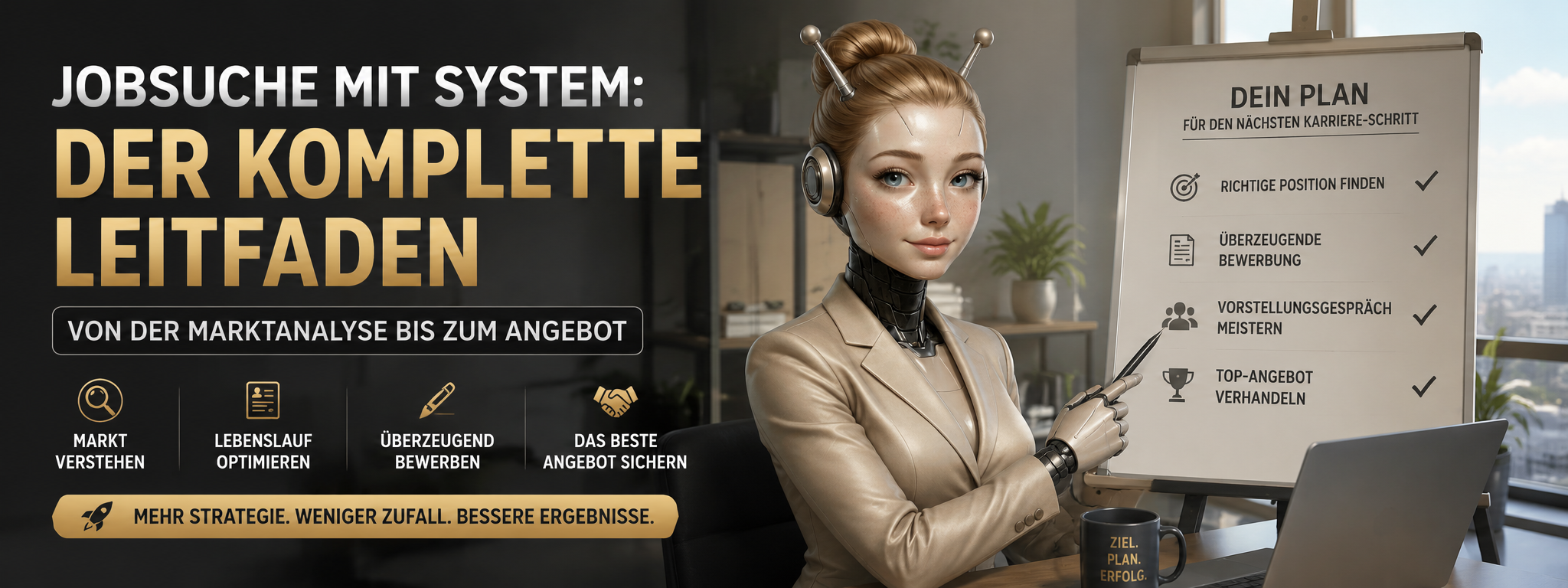
The uncomfortable truth about professional success
Most people who want to advance in their careers follow a simple logic: I work well and develop my skills — in return, I get income and promotion.
But the reality is different. Being able to work well is not enough for success. You also need to know how to market yourself and your experience in the job market.
This guide will help both those who haven't been job searching for a while and those who want to improve their position in the market.
Phase 1: Understand the Market Before You Start
The job search doesn't begin with applying — it begins with market analysis.
Study 20 to 30 job postings that theoretically fit you. Look closely: What skills are expected? What tasks are involved? And how much is paid?
One important point: Your experience often fits multiple different positions and career levels. You might be working as an analyst today, but you could just as easily apply for a product manager role. There are many such options. Examine all of them – this will maximize your search funnel.
First, determine which conditions are acceptable to you—and which are absolutely not. This will allow you to respond specifically to job openings and avoid wasting time with companies you wouldn't switch to anyway.
You can adjust your expectations during the search. But no preparation at all is risky: You might write an unsuitable resume or miss good opportunities.
A realistic timeframe: A job search can easily take half a year. This depends on the economic situation and your industry. Those who know this in advance can better plan their time, budget, and emotional resources.
Phase 2: The Resume – Three Principles That Matter
First, you should know one thing: most companies use automated filtering systems that check if you're a good fit for the position. Only after that does a recruiter take a look.
And the first glance at your resume lasts 6 to 10 seconds. During this time, it's decided whether you're even considered.
Three principles are crucial:
- Principle 1: Brevity. The resume should be one to a maximum of two pages. Nobody reads more.
- Principle 2: Relevance. Experience older than 10 years should no longer be included. Experience that is not relevant to the position should also not be included.
- Principle 3: Numbers. That is the most important point.
The most common problem: The resume reads like a job description
"Was responsible for purchasing and database maintenance." Sentences like this say nothing about you as a professional. Everyone in your position did approximately the same thing.
What works: Don't write tasks, but results with numbers.
Compare:
Before Created reports for management.
Later Automated reporting and saved the team 15 hours of work per week.
Before Responsible for advertising campaigns.
Later “Launched 12 advertising campaigns with a budget of 3 million — average ROI: 150 %.”
Numbers show that you bring benefits to the company. And you always want candidates like that.
Phase 3: The Cover Letter — Underestimated and Often Done Incorrectly
Many people ignore the cover letter or write it out of a sense of obligation. That's a mistake. For many positions, it's just as important as the resume.
The cover letter provides the employer with context that is missing from the resume. The resume answers the question: Who are you? The cover letter answers: Why this specific position—and what can you offer this company?
A good cover letter fits into three short paragraphs:
- Paragraph 1 — Your Experience at a Glance. How many years in the industry, where are you currently working, a few key skills, and achievements.
- Paragraph 2 — Experience in Detail. Read the job posting carefully. Understand what is required for this position, and briefly describe your relevant experience.
- Paragraph 3 — Your Motivation. Good motivation, for example, can be interest in the product, sympathy for the team or the founders, or shared values.
The most important rule: Do not repeat the resume. The cover letter does not duplicate information; it adds to it. If you could delete the cover letter without losing anything, then it is poorly written.
There’s an unwritten rule: No one reads the cover letter in detail. But 95% of recruiters prefer someone who has made the effort to do so anyway.
Phase 4: Where to Really Find Jobs
The major job portals don't contain all available positions. There are four main sources—and you should combine them instead of relying on just one.
- Job boards. The major job portals. Competition is highest here — one position often receives hundreds, even several hundred applications.
- Chapter 2: Departments and Channels. For every major profession, there are specialized channels and groups with good jobs — often more tailored and interesting than on the large portals. Simply search for "job openings" plus your industry.
- What 3: Company career pages. Companies often post job openings directly on their own websites. Applying directly through the company's website—without an intermediary—often increases your chances of getting a response. Look for "Careers" or "Jobs" on the company website.
- Quote 4: Recommendations – the most underestimated source. A significant portion of good jobs are filled before they ever appear on public platforms. For a company, it's easier and safer to hire someone vouched for by another person.
By all means, tell your network when you are actively searching: former colleagues, industry friends, anyone you've ever worked with. A social media post works, but a direct personal message is many times more effective.
And another tool that hardly anyone uses: directly contacting the company. Even if there are no open positions for you right now. Briefly introduce yourself, describe how you can be useful, and attach your resume. Minimal effort, sometimes an impressive result.
Phase 5: Applications — Think in Funnels
The job search works like a funnel. Here are approximate guidelines:
With good preparation, you'll get about 10 to 15 responses to 100 applications. With very good preparation, a large portion of those will be an invitation for an interview.
If you've sent out 10 applications and received 10 rejections, that's not yet a sign that something is wrong with you. That's normal. You should only draw conclusions when the number reaches the dozens.
Regarding strategy: Tailored applications work far better than mass applications. 10 applications with cover letters and a resume tailored to the position will bring more invitations than 100 standardized mass mailings.
The frequency should be consistent. Half an hour a day, five days a week—that's more effective than a 10-hour Saturday marathon. Job searching is a marathon, not a sprint. And a burnout in the second week has never helped anyone.
Create a table. The easiest way is an Excel or Google Sheet with the columns: Company, Job Link, Application Date, Status, Notes. Without this, you won't remember where you applied, who responded, or when an interview is scheduled after two weeks. This could cost you an offer.
Phase 6: The Interview - What to Look For
You have been invited. What awaits you?
First, a brief call with the recruiter – 20 to 30 minutes to get acquainted. If it goes well, there will be a conversation with the hiring manager – the person whose team you'll be joining. This usually takes about an hour. After that, a technical interview may follow: a case study, meeting other team members. And finally, a closing interview, usually with a senior leader.
The number of conversations varies greatly — sometimes it's one to two stages, sometimes up to ten. This depends on your position, career level, industry, company size, and whether you have recommendations.
Each phase has its own logic:
- In the first call, the recruiter checks the basics: suitability, motivation, willingness to accept the conditions, salary expectations. And whether you haven't exaggerated on your resume. His job: to weed out those who clearly aren't a good fit.
- The hiring manager is looking at something else: real experience, how you act in work situations, how you solve concrete tasks. Here you need stories, examples, numbers, and data.
- The final interview usually assesses whether you are a cultural and values fit. Will you fit into the team?
Three templates that you prepare once — and use forever
- Template 1 — The 1- to 2-Minute Self-Introduction When asked to talk about yourself, you shouldn't recount your biography from kindergarten. Prepare a brief self-introduction: your career path, key experiences, most significant achievements, and why you're looking for something new.
- Template 2 — Two to three stories from professional life. Prepare these stories using the STAR method (Situation, Task, Action, Result). This will allow you to describe both your successes and your failures. The stories you prepare will be sufficient to answer about 70% of the standard questions.
- Template 3 - Questions for Your Counterpart At the end of the conversation, you will be asked what you would like to know about the company. You must ask something here, otherwise you will be considered uninterested. Prepare 3 to 5 questions – about the team, the processes, the success criteria during the probationary period. Such questions show maturity and provide you with useful information for your decision.
Asking about salary and bonuses is permissible and worthwhile—but it's best to save these questions for the end.
Phase 7: The Offer — Accept or Not?
Congratulations, you have a job offer. The last question remains: to accept or not?
If something raises doubts, take a few days to think about it. This is common practice. During this time, you can calmly check if the conditions are right and if any questions remain open.
If you have another offer or are actively in discussions with another company, feel free to say so. This is not manipulation, but a normal part of negotiation. There is room here for careful, polite negotiation: If you want to go to one company, but another offers better terms, this can be used as an argument.
Therefore, do not stop your conversations with other companies and feel free to continue applying — even after you have received an offer and started your probationary period.
Conclusion: The documents are only 10 %
Now you know the basics. All that remains is to apply them.
Remember: Job hunting is a project that spans several months. Your documents—your resume and cover letter—are only 10% of it. The rest is methodical work: finding job openings and responding to them thoughtfully.
Whoever understands this as a system instead of a gamble will reach their goal with less stress and better results.
Editorial Note:This article summarizes best practices for job searching that are aligned with current labor market trends.





 Deutsch
  Deutsch (Österreich)
  Deutsch (Schweiz)
  English (Australia)
  English (Canada)
  English
  English (UK)
  हिन्दी
  العربية
  Türkçe
  Русский