
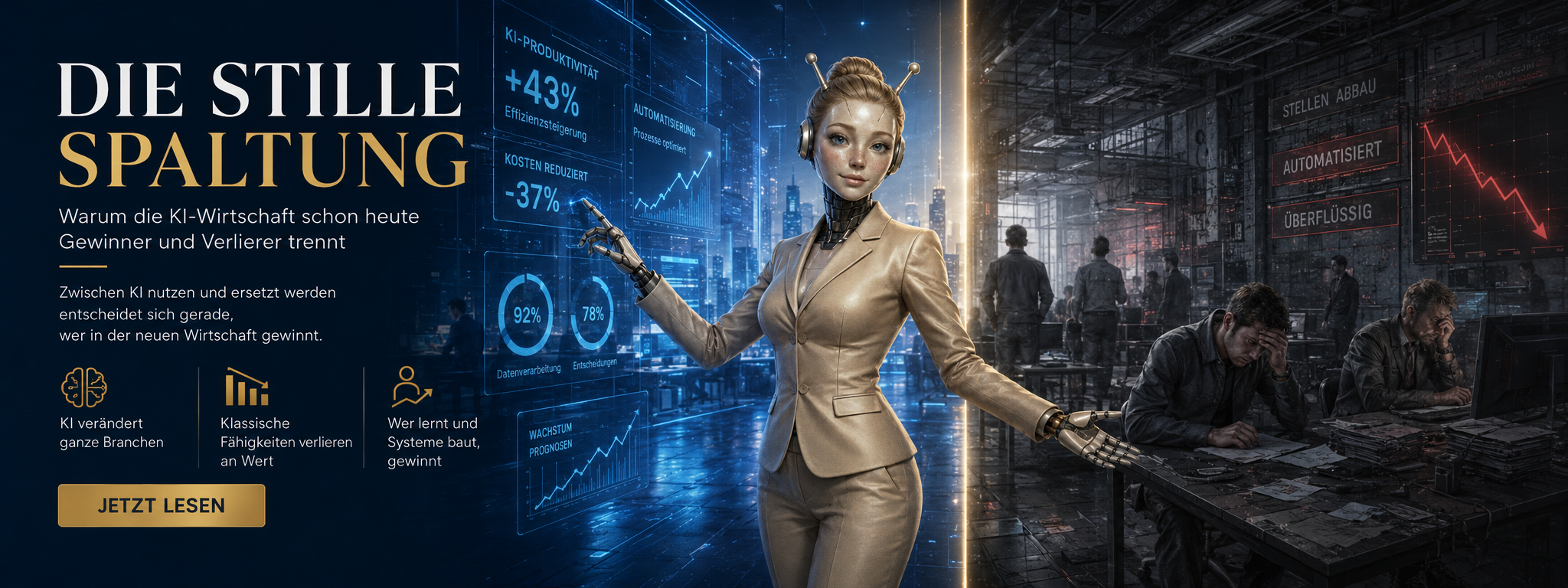
The Paradox of the "Smart" World
We live surrounded by ever-smarter technologies—and for many, life within them is becoming increasingly difficult. Smartphones are getting better, services more convenient. But in parallel, the real incomes of the middle class are falling.
It's tempting to blame inflation or political missteps. But that would be too simplistic. The more honest diagnosis is uncomfortable: the old economic model — school, graduation, stable career — no longer works in its classic form. Classic skills are losing value. A degree no longer guarantees a position.
Economic history knows such ruptures. With every industrial revolution, the majority of people temporarily became poorer, while a small group that had adapted early reaped enormous profits. What is happening today follows this pattern—only at a previously unknown pace.
How AI is Already Shifting Salaries Today
The displacement of human labor by AI is no longer a future vision, but measurable.
Creative economy
What used to take an entire studio—expensive equipment, photographers, retouchers, and weeks of work—is now often done by one person with AI tools. Speed and costs are changing by an order of magnitude. An entire supply industry (lighting, studio rentals, equipment) is losing its economic footing.
Logistics and domino effects
Drones conducting inventory in dark warehouses at night don't just save electricity. They don't just make warehouse workers redundant — but also those who provided them with food, clothing, or transportation to work. This causes an entire employment chain to collapse.
Knowledge work
The most inconspicuous but profound shift is happening here. The translation market has fundamentally changed in the last two years: For many standard texts, human labor is no longer competitive.
Accounting, entry-level consulting, call center activities, administrative tasks — algorithms are encroaching everywhere into areas that were considered "safe" just three years ago.
A concrete example: a well-known language learning service reduced about 10 percent of its translation partners last year. The creation of learning content was handed over to AI — humans only check the quality. This is not an isolated case, but an industry trend.
Why the education system doesn't help
A central weakness is the education system. It didn't originate in the 19th century to promote independent thinking — but rather to train reliable, literate workers for industrial society.
The "school → university → stable job" model worked for decades because the economy changed slowly. Knowledge from university was relevant for twenty years.
Today, the half-life of technical knowledge has shrunk to a few years. Anyone leaving university with a degree in design or law enters an industry that has fundamentally changed during their studies.
This is not a failure of the educators. This is a structural problem of a model designed for a different economic era.
Why governments won't solve the problem
Here, too, an honest assessment is in order. Governments see this trend—but they are caught in a dilemma.
On the one hand, they could slow down technological progress in certain areas to avoid social upheaval. Europe is already doing this with autonomous vehicles—restrictive regulations protect millions of professional drivers.
On the other hand, regulations cannot stop the spread of AI in design, accounting, or translation. These activities happen in the cloud, often across borders.
Two psychological traps
The Devaluation of What Is Free
We don't appreciate what's freely available to us. Online courses, tutorials, expert articles – everything within immediate reach. Yet, most people accumulate bookmarks and course registrations instead of actually working through the content.
Bookmarking creates the feeling of learning—without the actual learning.
Cheap dopamine supply
It's easier for the brain to derive short-term rewards from a TV series or a social media feed than to invest the effort required for real learning.
For thousands of years, avoiding knowledge had immediate consequences—hunger, physical danger. Today, distraction is freely available. The reward system isn't designed for this world.
What actually helps: three sober recommendations
-
Study time as a fixed amount—not as leftover time
Those who “study when they have time left over” don’t really study. A realistic estimate is about eight to twelve hours per week—set aside specific time slots in your calendar, ideally during times of the day when you can concentrate best. -
At least one professional-level AI tool
It’s not about “being familiar with AI.” It’s about mastering at least one tool— whether it’s an LLM chatbot, an agent-based development environment, or a specialized AI system— to a level that makes a measurable difference in productivity. -
Transition from Intuition to System
Entrepreneurs and professionals who organize their work the same way they did ten or twenty years ago are losing their competitive edge. Those who thrive in the new economy build systems with documented processes, clear interfaces, and measurable results.
Conclusion: The decision has to be made today, not “sometime”
The divide between those who use AI as a tool and those who are being replaced by it is not something that will happen ten years from now. It is happening right now — in the way people spend their weekends, evenings, and Wednesdays off today.
Nobody expects everyone to become an AI specialist. But everyone who is currently active in the workforce should ask themselves an honest question:
When was the last time I learned something substantial in my field? And what is the half-life of the skills I use to earn my income?
Anyone who answers these questions honestly has already taken the first step.
 Deutsch
  Deutsch (Österreich)
  Deutsch (Schweiz)
  English (Australia)
  English (Canada)
  English
  English (UK)
  हिन्दी
  العربية
  Türkçe