
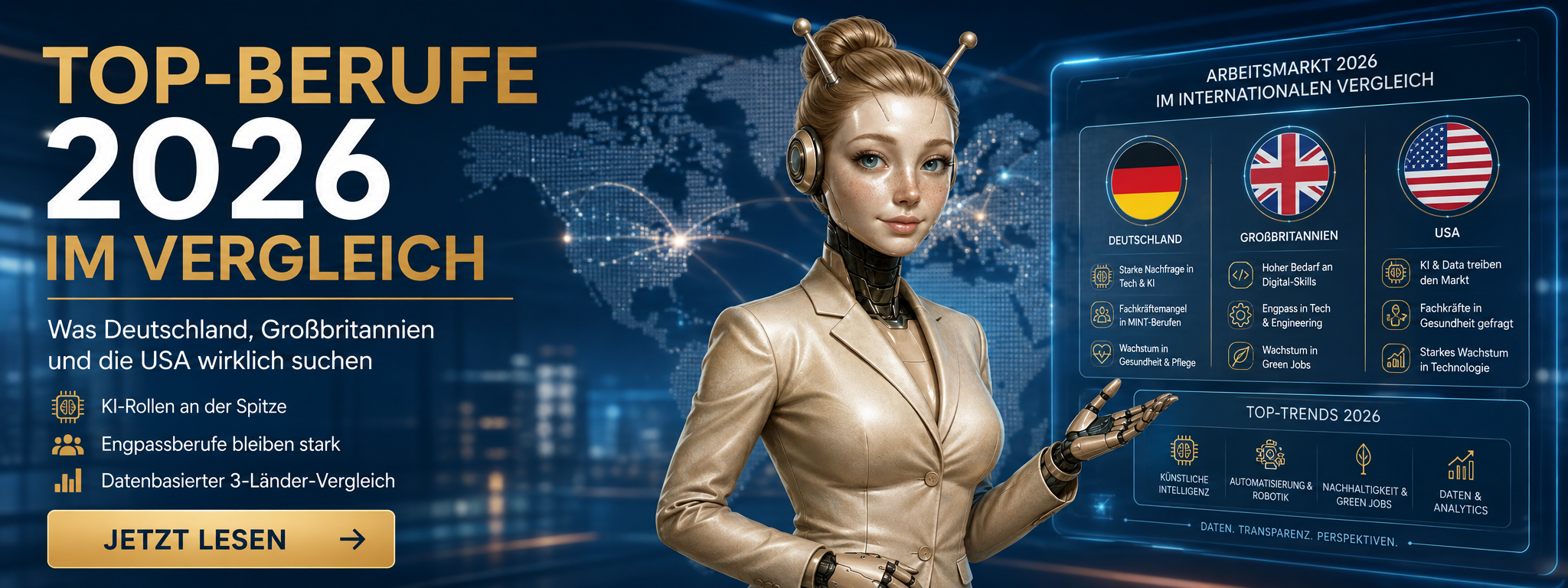
What Germany, Great Britain and the USA are really looking for
The most important thing in 30 seconds
In Germany, Great Britain, and the USA, the same three letters are at the top of the fastest-growing professions in 2026: AI. According to LinkedIn analyses for 2026 – based on millions of hires over the last three years – the roles of AI Engineer and Head of AI are among the top 3 in all three countries.
Around this core, three clearly recognisable movements are emerging: a surge in health and safety, risk, and compliance; strengthening demand for construction and infrastructure; and a noticeable shift towards self-employment – founders and independent consultants are pushing into the charts.
However, the ratio of "companies to open positions" shows drastic differences between the markets. The USA remain hot, Great Britain is cooling down considerably, and Germany is somewhere in between.
Germany
AI leads, but the bottleneck professions are called differently.
The top 10 fastest-growing professions in Germany for 2026 – based on hiring pace over the last three years:
- Head of Artificial Intelligence — LLM, RAG, MLOps; IT and Management Consulting; Munich, Berlin, Hamburg.
- AI Developer (ML Engineer) — LLM, RAG, PyTorch; Tech and IT Services; Munich, Berlin, Cologne/Bonn.
- Accredited Health and Safety Executive (HSE) - Incident Analysis, NEBOSH; Consultancy, Aviation, Chemical; Hamburg, Munich, Frankfurt.
- Claims Adjuster — Claims Management; Insurance, Legal Services; Munich, Cologne/Bonn, Münster.
- Geophysicist — 3D Seismics, Petroleum Geology; Consulting, Production, Engineering; Hanover, Munich, Hamburg.
- IT Specialist (Security/Infrastructure) — ISO 27001, Vulnerability Management; IT, Insurance; Munich, Frankfurt, Berlin.
- Head of Property Management — Commercial Real Estate, Development; Property, Capital Markets; Munich, Frankfurt, Düsseldorf.
- Contract Officer – Public Procurement, FAR; Insurance, Research, IT; Munich, Cologne/Bonn, Rhine-Neckar.
- Reporting Manager — Cash Flow, IFRS, Financial Reporting; Banks, Consulting, Insurance; Frankfurt, Cologne/Bonn, Hamburg.
- Private Equity Specialist – Financial Modelling, LBO, Valuation; Capital Markets, Consulting, Tech; Munich, Frankfurt, Berlin.
What the official statistics say about it
In parallel to these LinkedIn growth rates, the Federal Employment Agency, the IW Köln (Cologne Institute for Economic Research) and Make-it-in-Germany portray a different picture of structural bottlenecks: nursing (particularly intensive and elderly care), engineering, construction and craft trades, as well as the green energy transition with hydrogen technologies.
Important to understand: LinkedIn charts show the pace of hiring growth, not the absolute number of vacancies. For in-demand professions (healthcare, skilled trades, construction), the process is generally easier: visas are preferentially granted, accreditation is quicker, and there is a chronic need for staff.
2. Great Britain
AI leading, but the job market is shrinking
Britain presents a paradoxical picture in 2026: growth rates in AI roles are exploding – while the overall job market is weakening.
- AI Engineer (ML Engineer) — Design and implementation of AI models; London, Manchester, Bristol.
- Head of AI / Director of AI — LLM, MLOps, AI Strategy; Tech, IT, Consulting; London, Manchester, Glasgow.
- Machine Learning Researcher — PyTorch, Deep Learning.
- Strategic Advisor / Strategy Consultant — Growth in Self-Employment and Part-Time Consulting.
- Founder — Shift to Entrepreneurship and Gig Work
- Preconstruction Manager — Construction, Residential, Renewables, Transportation.
- Land / Land Acquisition Manager — Property Development, Construction Industry.
- Lecturer — Higher and Further Education.
- Clinical Psychologist — Mental Health; Growth of "Human" Professions.
- Chief Risk Officer / Head of Insurance — Risk Management and Regulatory Affairs.
The paradox of declining job numbers
LinkedIn has identified AI proficiency as the most important skill in the UK. At the same time, the total number of vacancies is around 10 percent below pre-pandemic levels. In the construction industry, the number of vacancies has fallen particularly sharply year on year – making the rise of preconstruction and land managers particularly insightful: demand is shifting to the early project phase, before the actual construction contract is awarded.
A second perspective — Indeed Opportunity Index 2026: In addition to AI engineers, renewable energy engineers, skilled tradespeople (electricians, plumbers), public sector employees — and even Pilates instructors — are on the rise on the island. In other words: occupations that involve manual labour or direct human interaction and are difficult to automate.
3. USA
AI boom in full swing
In the United States, development is proceeding most markedly, while at the same time the broad labour market is cooling.
- AI Engineer — LangChain, RAG, PyTorch; San Francisco, New York, Dallas.
- AI Consultant / Strategist — LLM, MLOps, Computer Vision; San Francisco, New York, Boston.
- New Home Sales Specialist — Residential Property; Houston, Dallas, Orlando.
- Data Annotator — Data Labelling for AI Training; Austin, New York, San Francisco.
- AI / ML Researcher — PyTorch, Deep Learning, Computer Vision.
- Healthcare Reimbursement Specialist — Medicare/Medicaid, Prior Authorisation.
- Strategic Advisor / Independent Consultant — Executive Advisory, Go-to-Market Strategy.
- Advertising Sales Specialist — Media Planning, Paid Social.
- Founder — Startup Leadership, Software Development.
- Sales Executive — C-Level Management, International Markets.
Four out of five fastest-growing roles – all linked to AI
The number of AI Engineer positions has grown by approximately 143 percent within a year. The salary premium for AI skills is around 56 percent.
But remarkable things are also happening outside the tech industry: Housing vendors, medical reimbursement specialists, and data annotators are also growing strongly. The shift to self-employment is also evident — founders and independent consultants are pushing into the top 10.
But caution regarding the overall picture: while AI roles are growing the fastest, the US labour market as a whole is cooling. The total number of job openings has fallen to ~6.9 million – the lowest level since 2020/21. Entry-level positions are shrinking particularly, and basic AI competency is increasingly expected for market entry.
4. How hot is the market really?
Companies versus Vacancies
One of the most telling indicators of the labour market situation is the ratio of companies to vacancies. This shows how differently the three markets tick:
Germany
- Companies: ~3.2–3.3 million businesses (Destatis 2023)
- Vacancies: ~0.63–0.70 million (BA / IAB)
- Ratio: ~0.20 — 1 position per 5 companies
Great Britain
- Businesses: ~5.7 million Businesses (DBT BPE 2025)
- Vacancies: ~0.705 million (ONS, Feb–Apr 2026)
- Ratio: ~0.12 — 1 star out of 8 businesses
USA
- Companies: ~8.2 million establishments / ~6.1 million employer firms
- Vacancies: ~6.9 million (BLS JOLTS, March 2026)
- Ratio: ~0.84 / Establishment; ~1.1 / Firm
How these numbers are to be read
USA — the hottest market in terms of job density.
Around 6.9 million vacancies across 8.2 million business sites equate to approximately 0.84 jobs per location. Calculated based on 6.1 million employer firms, it is around 1.1 jobs per firm. If you include the 29.8 million self-employed individuals without staff, the density is significantly lower — but that distorts the picture.
Germany — intermediate level.
Around 0.63 to 0.70 million job vacancies across approximately 3.2 to 3.3 million businesses result in roughly one vacancy for every five companies. The market has been cooling since its peak in 2022/23, but demand remains high in "shortage occupations."
The UK — has seen the sharpest slowdown.
Around 705,000 vacancies across 5.7 million businesses work out at roughly one job per eight businesses. However, 74 per cent of UK businesses are sole traders with no employees – among actual employing firms, the density is considerably higher.
Another British indicator: According to the ONS, there are currently around 2.5 unemployed people per vacancy (January–March 2026) – compared to ~1.8 to 2.0 a year ago. This confirms the cooling of demand..
Which limits comparability
5. What this data actually means for applicants
Anyone looking for a job or planning a career change in 2026 should draw four practical conclusions from these figures.
Firstly, AI literacy is no longer a bonus – it's a prerequisite.
This applies not only to AI specialists but increasingly to any role that works with data, texts, or processes. Anyone applying in 2026 without a basic understanding of LLM tools will be at a disadvantage – regardless of their profession.
Secondly: The fast-growing professions are not always the professions with the most jobs.
LinkedIn charts show the pace of growth. For the actual bottleneck professions – nursing, skilled trades, construction, engineering – the absolute demand is higher, competition is lower, and the hurdles for foreign applicants are lower.
Thirdly: Independents are breaking into the charts.
"Founder" and "Strategic Advisor" are in the top 10 in both the US and the UK. This is no coincidence – but a reflection of structural change. Permanent employment is no longer the only path. Fractional roles, consulting activities and micro-entrepreneurship are gaining importance.
VFirstly, the country makes the difference.
An AI engineer in San Francisco has a different negotiating position than an AI developer in Hamburg or London. Those who are geographically flexible should take advantage of that. Those who aren't should at least understand the local nuances – and for example, in Germany, also check the lists of skilled occupations in short supply.
Conclusion: The future is AI — but not solely
The fastest-growing occupations in 2026 tell a clear story: Artificial intelligence dominates in all three major Western markets. But the picture isn't one-dimensional. Around it, risk and compliance are booming, construction and infrastructure are making a comeback, people-focused occupations (psychologists, lecturers, care) are growing – and self-employment is becoming a mass option. Anyone who reads the job market in 2026 soberly will see: there isn't one growing occupation. There is a clear trend towards hybrid profiles – people who combine technical and human competencies, who are confident working with at least one AI tool, and who are willing to redefine their role every few years.
Methodological note
The LinkedIn "Jobs on the Rise" charts measure the growth rate of hirings over the last three years – not the absolute number of vacancies or salaries. They are based on LinkedIn user profiles, which is why knowledge workers and white-collar professions tend to be overrepresented in the lists. For in-demand roles in nursing, skilled trades, and medicine, official statistics from national employment agencies supplement the picture. Sources: LinkedIn Jobs on the Rise 2026 (Germany / UK / USA, Jan.–Feb. 2026); Indeed Opportunity Index 2026 (UK); Destatis; Federal Employment Agency / IAB; ONS (UK); DBT Business Population Estimates 2025; BLS JOLTS (USA); U.S. Census Bureau SUSB.



 Deutsch
  Deutsch (Österreich)
  Deutsch (Schweiz)
  English (Australia)
  English (Canada)
  English
  English (UK)
  हिन्दी
  العربية
  Türkçe
  Русский