
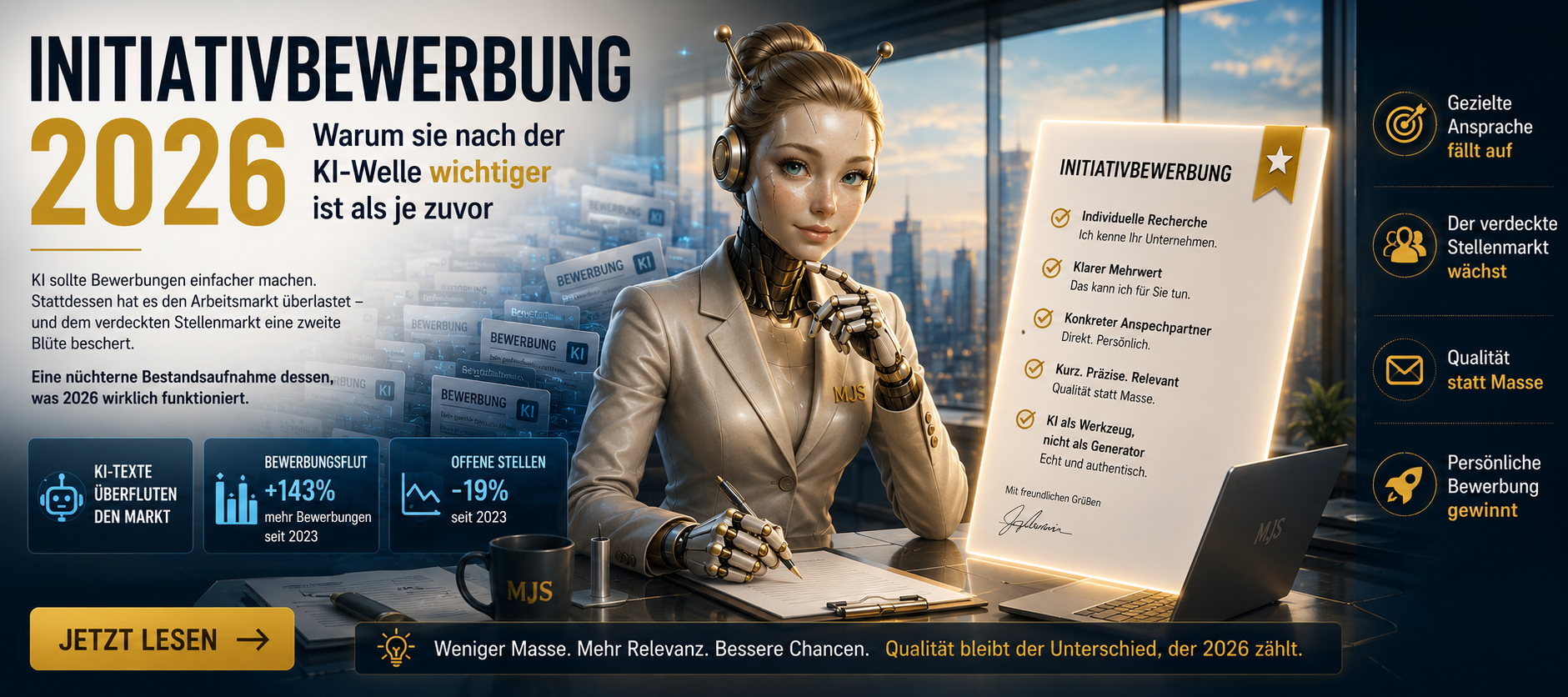
will 2026 really work.
The paradox: More applications, less success
In theory, 2026 should be the best year for applicants in a long time. Generative AI tools make it possible to write a professional-looking cover letter in minutes.
Where people used to spend hours on their CVs, they now get twenty suggested phrasings in seconds.
The practice is different.
Recruiters are reporting more applications than ever before — and at the same time, that it has become more difficult to identify suitable candidates.
According to the StepStone Group's 2023 to 2026 Hiring Trends Update, application numbers have almost doubled.
At the same time, the officially reported job vacancies are around 624,000 – a level last seen during the Corona slump in 2020.
More competition for fewer jobs, plus a flood of AI-generated standard texts – the result is what Greenhouse HR software CEO has publicly dubbed the „AI doom loop“.
What has changed technically
Three parallel developments are shaping the application process in 2026.
1. AI is mainstream - on both sides
According to the Bitkom AI study 2026, 41 percent of German companies are actively using AI.
a further 48 percent plan to deploy it. For companies with more than 500 employees,
usage at over sixty percent. Which for HR departments means: whoever filters, scores or summarises an application,
does this increasingly with algorithms
On the applicant page, the spread is even more evident. Anyone composing a cover letter in 2026,
likely uses some form of AI support.
This is not reprehensible — but it changes the rules of the game.
2. ATS filters have become stricter
Applicant Tracking Systems – also software that automatically searches applications for keywords
searches — have been standard in large German companies for years.
In 2026, they were supplemented with AI components that not only count words but also evaluate semantics and recognise stylistic features.
One consequence: standardised AI texts are increasingly being recognised. Application professionals unanimously report that overtly AI-generated cover letters are highly likely to end up in the rejection pile.
3. HR managers work under economic pressure
The unemployment rate in Germany reached 6.6 percent in January 2026
its highest level since 2013.
The number of vacancies has fallen by around 19 percent year-on-year. 36 percent of companies are reviewing internal teams, and 25 percent have made redundancies.
a further 25 percent have slowed or stopped recruiting.
In such a market, every attitude is subject to risk calculation.
An HR manager faced with a hundred AI-polished applications will find it difficult to distinguish between the honest
candidates and the prompt-engineered can hardly be distinguished.
back to familiar channels — recommendations, personal contacts,
Speculative applications and direct approach.
The Renaissance of the Hidden Job Market
This brings us to the actual trend.
The hidden job market – in other words, all positions that are filled without public advertisement – will structurally gain importance in 2026.
What the data really says
In virtually every German career guide, it states: "50 to 70 percent of all jobs are never advertised publicly."
This number is repeated so often that it has become a given. On closer inspection, however, the source material is thinner than its prevalence would suggest.
The most robust surveys come from the Institute for Employment Research (IAB).
The order of magnitude "approximately half of all new hires are made without public advertisement"
is plausible and well-documented.
The often-quoted 70 or even 85 percent for leadership positions
are less resilient.
The hidden job market is real and substantial. Focusing on exact percentages is less important,
to understand why it is currently growing.
Why companies are currently filling positions internally
Three reasons will be particularly strong in 2026.
Firstly, cost. An unfilled vacancy means recruitment effort,
ATS configuration and often external advice.
Secondly, risk mitigation. A recommended candidate or a well-prepared speculative application is easier to assess than the hundredth application from the ATS pile.
Third, speed. Particularly within the mid-market, positions are often filled at short notice. An unsolicited application at the right time can replace the entire recruitment process.
What has changed for speculative applications
The speculative application as a format is not new.
But the rules by which it operates in 2026 have changed.
What no longer works
Standard cover letter with AI assistance. Clichés like "Dear Sir or Madam, I have become acquainted with your company with great interest..." are particularly quickly thrown in the bin today.
Mass distribution of identical letters no longer works either. Modern systems recognise duplicates, and HR managers recognise patterns.
Generic lists of strengths such as "team player, resilient, communicative, and solution-oriented" now contain hardly any usable information.
Will 2026 really work
The answer lies in a combination that has paradoxically become more difficult in the AI age: genuine personalisation through genuine research.
- Concrete research on the company
Anyone who shows in the first few lines that they actually know the company automatically stands out from the majority of applications. - Clear professional added value
Don't explain what you can do – but what concrete benefit you can bring to this company. - Direct address to a specific recipient
A personal contact person signals preparation and genuine interest. - Short form
Modern cover letters often range from 250 to 350 words. A good half-page often trumps a full page of standard text. - AI as a tool, not a generator
AI helps with structure, correction and optimisation
The actual content should predominantly come from the applicant.
The real problem: Time and discipline
The recommendations are not complicated. However, they are labour-intensive.
A really good, personalised speculative application costs between
30 and 90 minutes per company.
Anyone wanting to target thirty to fifty companies will quickly invest between 15 and 75 hours of concentrated work.
Alongside a current job or family commitments, many application projects fail
exactly that effort.
This is why a new market has developed in recent years:
specialised agencies that research, personalise, dispatch and track
take on professionally.
What a professional speculative application looks like in practice
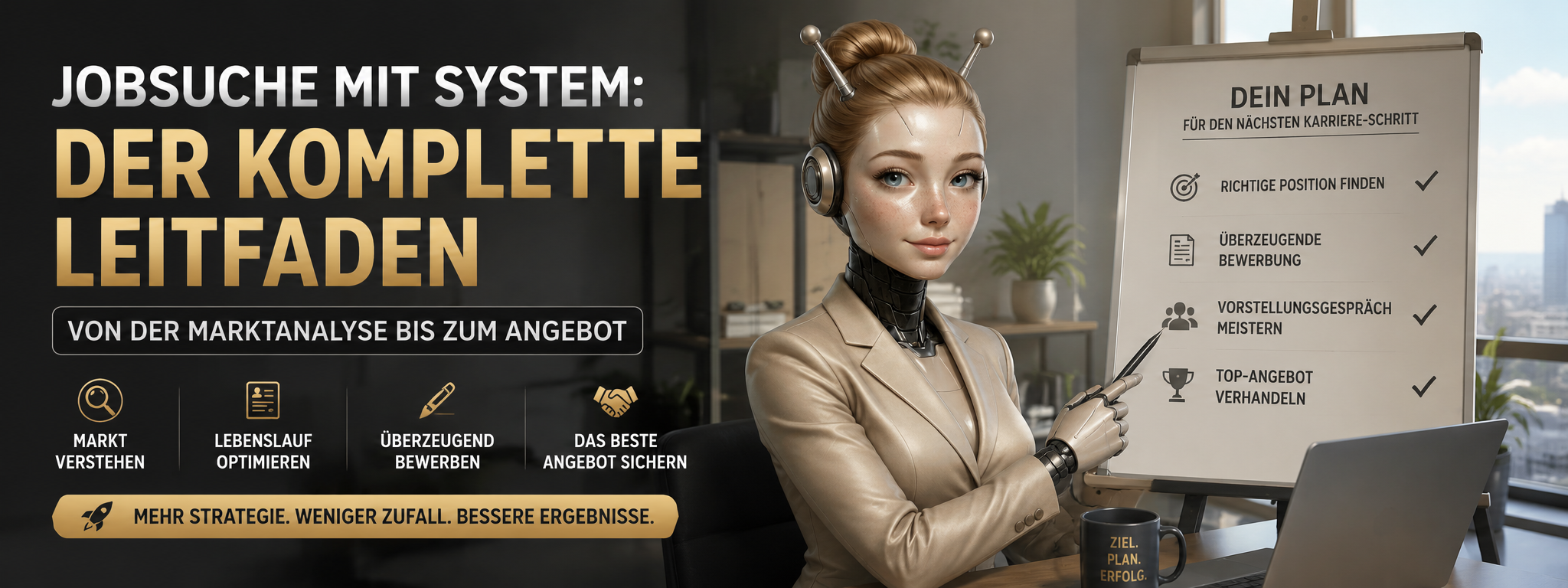
Step 1: Profile and Target Market Analysis
Work experience, skills, regional preferences, and career goals are analysed,
to identify suitable target companies.
Step 2: Creating professional application documents
CV and cover letter will be ATS-compatible, visually high-quality
and built to current standards.
Step 3: Research and Personalisation
Contact person, corporate development and specific application possibilities
are researched individually.
Step 4: Structured Dispatch and Tracking
Applications will be sent out as planned, responses will be documented
and conversations professionally prepared.
Step 5: Payment upon success
Many premium providers work with success fee models,
whereby remuneration is only paid upon successful placement.
When professional support is worthwhile – and when it isn't
When it makes sense
- Career change with time pressure
- Career change or industry change
- Highly qualified positions with a high application effort
- International candidates without DACH experience
- Career change from 40+
When it is not really necessary
- High-demand junior positions
- Existing strong networks
- Sufficient time for extensive independent research
Realistic figures on success probabilities
With classic applications for public jobs, the chance
at an invitation often only in the low single-digit percentage range.
Well-prepared speculative applications achieve significantly higher scores,
especially when they are specifically tailored to companies and contact persons.
Anyone who sends out thirty high-quality unsolicited applications,
statistically has better chances than someone who sends out three hundred standard applications.
Moreover, only a small proportion of all jobseekers actively utilise the hidden job market. This fact alone significantly reduces the competition.
Conclusion: A new value for an old channel
The AI wave has not destroyed the job market. It has shifted it.
Standardised mass applications have lost value, while personal, well-researched unsolicited applications are once again among the most effective job-seeking tools.
Those who rely solely on public job boards in 2026 will be competing with hundreds of similarly worded applications.
Those who also make use of the hidden job market operate in an environment with significantly less competition and often greater attention from employers.
The question is no longer whether the hidden job market works.
The question is simply whether you will handle it yourself – or make use of support to implement it consistently and professionally.
Whoever has understood this has already taken the first step.
Methodological note
The statistical data in this article is based on public data from the Federal Employment Agency, the Institute for Employment Research (IAB), the StepStone Group's Hiring Trends Update 2026, and the Bitkom AI Study 2026.
The figures mentioned are for the classification of market trends and may change over time.
 Deutsch
  Deutsch (Österreich)
  Deutsch (Schweiz)
  English (Australia)
  English (Canada)
  English
  English (UK)
  हिन्दी
  العربية
  Türkçe
  Русский