
A rule of thumb that sums it all up
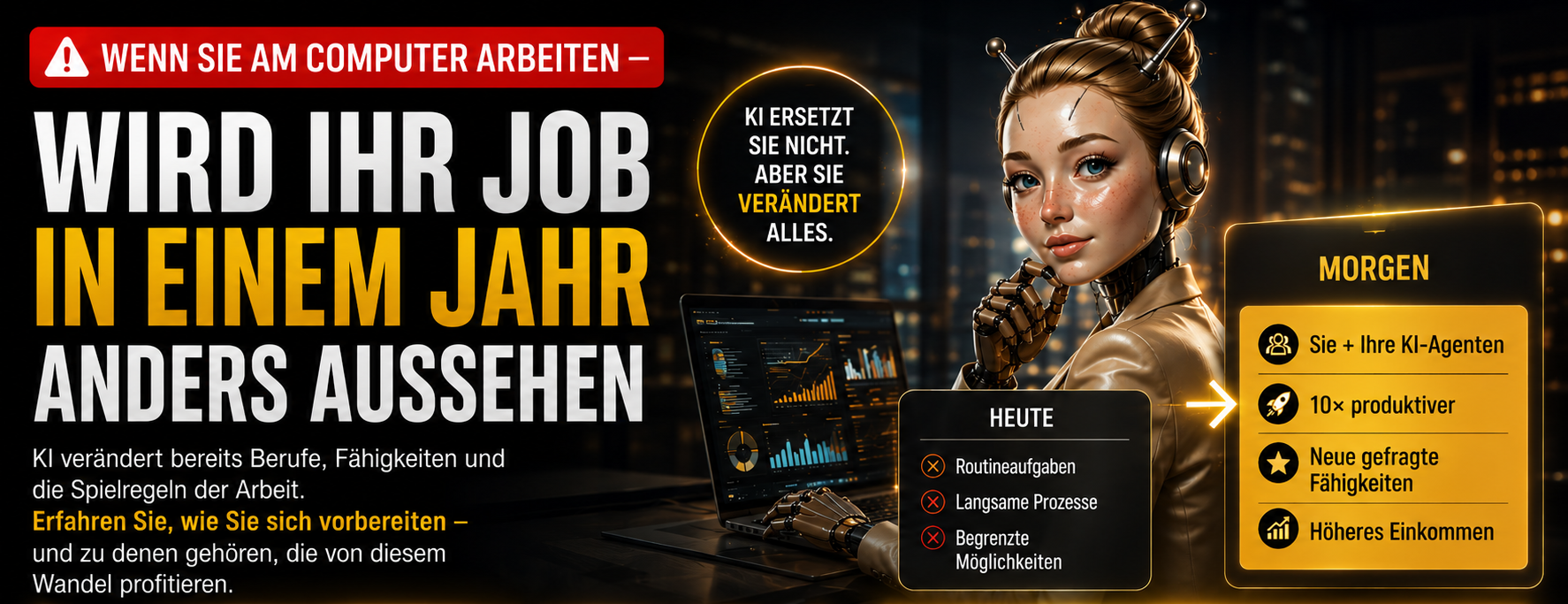
If your work means you sit at a computer, stare at a screen, and type on a keyboard — your job will look different in a year. This isn't a threat. It's also not a prediction from a crystal ball. It's the sober observation of professionals who have been using AI tools in practice for years. What's important here: It's not about AI replacing you. Programmers were predicted to be the first to be replaced two years ago. They are all still here. But their tasks, their productivity benchmarks, and the form of their work have changed. This is exactly what is happening right now in almost every office job.The Model of the Future: You Plus Your Agents
There's a term that best describes today's most productive people: One Man Team — a team of you and your AI agents. When someone like this starts at a company, they don't come alone. They bring their team with them. And this team accelerates them by a factor of 10. Important: An AI agent is not like Photoshop or Excel. It's more like a fully-fledged employee. And that means: You have to train them. Just like a human colleague."In the beginning, we were both helpless. I didn't know how to work with him. He didn't know how to work with me. We'd agree on something, he'd forget it, we'd learn how to make sure he didn't forget anything... Today, I just tell him: 'A new podcast has been released, summarize it for me.' And he understands on his own which podcast it is and where the summary needs to go. Several months of onboarding were necessary — but now he takes tons of routine work off my plate."
The typical beginner mistake: no onboarding. This means giving the AI tool too little context. AI works mediocrely "out of the box." The more personal information it receives, the more effective it becomes.
A concrete guide: How do I understand how my job is changing?
Here is a simple algorithm for anyone who wants to figure out how their own profession will change under the influence of AI. This method works for any AI brainstorming — you just change the context.- Step 1: Pay for an LLM
Free versions are massively restrictive. For about 20 Euros a month, you get a fundamentally different tool. - Step 2: Give the AI context about yourself
The more, the better. Who you are, what you do, how old you are, what market you work in. Give her your resume. Give her your LinkedIn profile. Save all that in a project so you don't have to repeat it with every request. - Step 3: Honestly ask the question that is really on your mind
For example: "I'm worried about how my profession will change in the next two years. Let's brainstorm together about what changes will actually happen—and what I can do to be prepared and become a leader in those changes."
👉 Important: Activate the strongest available model with Extended-Thinking mode. Add to the end of the request: "Ask me as many follow-up questions as needed and wait until I've answered them. Then we'll continue thinking together."
After a few iterations — where you answer the AI's questions — you get really useful ideas.
What if the company blocks AI?
This is where it gets tricky. Some companies are already exclusively looking for candidates with AI skills. Others—especially in conservative industries like finance or healthcare—are blocking AI tools completely. Examples from practice: "Copilot is available here, but you have to apply for approval. Claude is not accessible at all—IT security hasn't approved it." This is called the "Faraday cage" policy. But here's the important observation:The most successful examples of AI adoption in companies have always come from the bottom up. Employees started using AI themselves, and then permission came from above. Top-down adoption – "We've paid for your subscription, now use it" – fails in most cases.
Practical advice: Automate your workflows on your own initiative. Even conservative companies understand the value of employees who work faster and can optimize their processes.
If AI at work is absolutely taboo: do pet projects in your free time. That's exactly what we're getting to now.
Wie man KI-Kenntnisse im Lebenslauf hervorhebt: * **Erstellen Sie einen eigenen Abschnitt für KI-Kenntnisse:** Dies hilft Personalvermittlern, Ihre spezifischen Fähigkeiten auf einen Blick zu erkennen. * **Seien Sie spezifisch:** Anstatt nur "KI" zu schreiben, listen Sie die spezifischen KI-Tools, Programmiersprachen und Frameworks auf, mit denen Sie vertraut sind (z. B. Python, TensorFlow, PyTorch, scikit-learn, maschinelles Lernen, Deep Learning, natürliche Sprachverarbeitung, Computer Vision). * **Quantifizieren Sie Ihre Erfolge:** Wenn möglich, geben Sie konkrete Beispiele dafür, wie Sie KI-Kenntnisse eingesetzt haben, um messbare Ergebnisse zu erzielen. Zum Beispiel: "Entwickelte ein Machine-Learning-Modell, das die Vorhersagegenauigkeit um 15 % verbesserte." * **Integrieren Sie KI-Kenntnisse in Ihre Berufserfahrung:** Beschreiben Sie in Ihren Aufgaben und Verantwortlichkeiten, wie Sie KI-Technologien eingesetzt haben, um Projekte abzuschließen oder Probleme zu lösen. * **Heben Sie relevante Projekte hervor:** Wenn Sie an KI-bezogenen Projekten gearbeitet haben, erwähnen Sie diese und beschreiben Sie Ihre Rolle und die verwendeten Technologien. * **Verwenden Sie relevante Schlüsselwörter:** Informieren Sie sich über die in Ihrer Branche üblichen KI-Schlüsselwörter und integrieren Sie diese in Ihren Lebenslauf. * **Passen Sie Ihren Lebenslauf für jede Bewerbung an:** Wenn Ihre KI-Kenntnisse für eine bestimmte Stelle besonders relevant sind, stellen Sie sicher, dass Sie diese im Abschnitt "Kenntnisse" und in Ihrer Berufserfahrung hervorheben. * **Erwähnen Sie Zertifizierungen und Weiterbildungen:** Wenn Sie Kurse oder Zertifizierungen im Bereich KI absolviert haben, listen Sie diese auf. Beispiele für Formulierungen: * **Kenntnisse:** * Programmiersprachen: Python (mit Bibliotheken wie NumPy, Pandas, Scikit-learn), R, Java * KI/ML-Frameworks: TensorFlow, PyTorch, Keras, XGBoost * Techniken: Maschinelles Lernen (Supervised, Unsupervised, Reinforcement Learning), Deep Learning (CNNs, RNNs, LSTMs, Transformatoren), Natürliche Sprachverarbeitung (NLP), Computer Vision, Datenanalyse, Datenvisualisierung * Tools: Jupyter Notebooks, Git, Docker, Cloud-Plattformen (AWS, Azure, GCP) * **Berufserfahrung:** * "Entwickelte und implementierte ein prädiktives Wartungsmodell unter Verwendung von maschinellem Lernen und Python, was zu einer Reduzierung ungeplanter Ausfallzeiten um 10 % führte." * "Leitete die Entwicklung eines NLP-gestützten Chatbots zur Verbesserung des Kundenservice, was die Bearbeitungszeit für Anfragen um 20 % verkürzte." * "Analysierte große Datensätze mithilfe von Deep-Learning-Techniken, um neue Muster und Erkenntnisse für die Produktentwicklung zu identifizieren."
That depends on where you are applying:- AI-First Companies Highlight AI skills prominently—even if you haven't used them professionally. Mention them at the top of your profile. Create a separate "AI Projects" section after the current work experience.
- Conservative Industries A brief mention in the skills section is sufficient here.
Examples of meaningful pet projects
- An automated job search system that researches companies, evaluates their relevance, and semi-automatically adapts resumes and cover letters
- A shared context system for a team, so that each employee works with their AI assistant — and all assistants know the same thing about the company
- A system that analyzes all of an author's posts on one platform and helps create content in the same tonality on other platforms
Emotional intelligence; critical thinking; creativity; ethical judgment; problem-solving in novel situations; interpersonal communication; leadership; empathy; intuition; strategic thinking; subjective decision-making; moral reasoning; contextual understanding; adaptability to unforeseen circumstances; and the ability to form genuine human connections.
These skills become the "hard currency" — and should be highlighted on every resume. First: Achieving results with people. A few years ago, managers were willing to hire a difficult candidate because of their technical strengths. Today, soft skills and negotiation ability are becoming more important. Second: Experience and judgment. You can have any number of AI agents do any amount of work — but the human decides whether to accept the result or not. Because the human bears the responsibility.Judgment is a direct function of your experience. When you really know something, when you can distinguish a good solution from a bad one — that's a superpower. You have to train it.
Third: Leadership and task assignment. This is new—and affects everyone.
In 2026, we will all be Switchers. In addition to our actual professions, we will all become managers of our AI agents.
AI writes better code today than most programmers—but only if the task is formulated correctly: with a clear description of the desired outcome and an understanding of how to verify that the outcome has been achieved.
In other words: AI raises the bar. If you are mid-level, senior-level will be expected of you. You will need to guide your AI agent as you would guide your own junior: clear tasks, clear success criteria.
What should junior employees do?
On the topic of juniors. Traditionally, career starters built on repetition: they performed simple, monotonous tasks and learned how more complex work functions. This path no longer exists. AI is now doing what used to be junior tasks.The practical advice: Juniors should learn to master AI and aim directly for mid-level.
"If you've set up your own AI junior to do monotonous tasks for you – you're already on another level."
How does one learn to no longer fear AI?
Spend time with people who are already using AI It's very easy to fall into a circle of tiresome skeptics who repeatedly say, "This bubble will burst, and then we'll see... They want to replace us? Look at how many files there are here—who could possibly replace us?" Such conversations give you a sense of superiority (because only you know it's all just hype) and—more dangerously—a false sense of security. This cynicism is destructive. In a few years, you risk being hopelessly left behind. Allow yourself to experiment — and to fail Don't take your AI projects too seriously at the beginning: "I will now build an app and sell it for billions." This seriousness will only slow you down. Start with something simple—something that personally interests you.Remember how you played as a child? In childhood, we do many things simply "for fun." Why skateboard, for example? What use is that skill later in life? For nothing. It's just fun. This attitude helps me enormously today. I don't do pet projects to make money or present at a conference. I do them because I want to. That's how you learn incredibly fast.
The biggest obstacle: people limit themselves. At the words "Open Claude Code…", someone immediately shuts down and says, "Code? But I'm not a programmer."
No one expects you to become the world's best developer. To get started, the knowledge you already have is enough. You'll learn the rest through trial and error.
The Dark Side: AI Brain-Fry and FOMO
But not everything about AI is optimistic. There's a paradox: AI agents increase productivity but don't make work easier. Previously, a workday was structured like this: demanding tasks alternated with routine — and the brain recovered during the routine. Today, you can delegate routine tasks to AI and immediately turn to the next project. There's no room for recovery. The result is called "AI Brain Fry" in English-speaking countries — chronic cognitive overload.When you work with AI, you get dopamine from quick results. What used to take a week can be done in a few hours! The reward system in the brain says, "You're great, let's keep going. We can accomplish so much more!" And then you continue working in the freed-up time.
Added to this is FOMO—the fear of missing out. "So much is happening at once—how can I not fall behind?" Everyone who actively integrates AI into their work knows this feeling.
How to survive the AI pace?
Focus on a niche One of the main causes of FOMO: the feeling that you have to try everything at once. Choose an area that truly interests you and focus on it. Immediately apply what you've learned.When a new video generation tool comes out, I say, 'Sounds cool, but it's not for me.' On the other hand, when a tool comes out that is thematically close to me, I'm one of the first to try it. I invest my attention in a narrow area.
Don't keep switching tools.
If you've started with a tool, work with it for at least a month. Constantly switching between environments broadens the horizon but only leaves superficial understanding. A month is enough to reach the tool's limits, recognize best practices, and develop your own working patterns.
Rest
Real days off are not laziness—they are necessary. Complementary to this, a system with clear deadlines helps: After a certain work period, you convene a review for yourself.
I make an agreement with myself that I will work in active mode until a certain date — and then I will sit down at the negotiation table with myself and clarify: Where have we ended up? Was it worth it? What should I focus on next? This is how I develop a new contract with myself.
What tools – and for what?
A proven breakdown in practice:- Images and logos: A fast image generation tool. Fast generation, many variations at once.
- Complex multi-factor questions: A model with a large context window — for legal and medical questions where many variables need to be considered simultaneously.
- General Main Partner A conversational model for everything else. Tasks are posed as if to a business partner.
- Context Storage A note-taking tool like Obsidian, where you and your AI agents can work together.
Practical Tip: Test new tasks on multiple models simultaneously. Give the same task to two different models and compare the results.
Conclusion: There is no panic — but there is urgency
The core message can be reduced to three sentences: AI will not replace you. But someone who uses AI better than you will.The skills that truly matter are no longer purely technical—it's judgment, task delegation, communication. That's precisely what AI can't do.
And the easiest first step? Pay for an LLM. Give it context about yourself. Ask an honest question. The rest will follow from there.
Nobody expects you to be an AI genius tomorrow. But whoever has the same job in a year as they do today—and does it the same way—will probably run into problems.
Editorial Note:This article is based on an expert discussion about the practical integration of AI into professional life. The recommendations and observations presented reflect the experiences of experienced AI users.



 Deutsch
  Deutsch (Österreich)
  Deutsch (Schweiz)
  English (Australia)
  English (Canada)
  English
  English (UK)
  हिन्दी
  العربية
  Türkçe