

No more forecasts – real data
For years, economists, business consultants, and technologists have predicted which professions will disappear due to artificial intelligence. The predictions were mostly dramatic – and just as often wrong. The panic about outsourcing in the early 2000s cost far fewer jobs than predicted. The wave of automation in industry proceeded more slowly and selectively than expected.The fundamental problem with these forecasts has always been the same: they were based on what machines could theoretically achieve, not on what they actually do in everyday life. A language model can theoretically draft legal documents, create financial reports, and debug code. But how often does that actually happen? To what extent? In which professions?
A study by Anthropic researchers is now answering this very question: Maxim Masenkov and Peter Macroory have developed a new metric – the so-called Observed Task Coverage (OTC). And the results are as astonishing as they are insightful.
The Method: Theory Meets Reality
Researchers combined three data sources:- O*NET – the US federal occupational classifier. This database breaks down every occupation into precise micro-tasks with time allocations.
- Theoretical AI Performance Assessment – Estimates of how much AI can accelerate tasks.
- Real usage data of the Claude model – what tasks people actually delegate to AI.
The Food Processor Paradox
To illustrate the core problem of previous studies, the researchers use a vivid analogy:A food processor can theoretically cook a five-course meal – but in practice, it's usually only used for chopping onions.
The exact same applies to AI. The central question is not what it can do – but what is actually being used. The answer: We're still at the "onion slicing" stage.
The Numbers: The Gap Between Potential and Reality
An example from practice:- Theoretical AI Potential (IT Professions): 94 % of tasks
- Actual usage: only about 3 %
- Legal liability (e.g., medical, legal)
- Outdated IT infrastructure in companies
- Human control and decision-making processes
👉 The limitation is not technological - but institutional.
Who is really at risk? The ranking
| Rank | Occupational field | Observation coverage | Main task |
|---|---|---|---|
| 1 | Programmer | 74,5 % | Write and maintain code |
| 2 | Customer support | 70 % | Communication |
| 3 | Data input | 67 % | Data processing |
| 4 | Medical Documentation | ~55 % | Create reports |
| 5 | Marketing analysis | ~50 % | Reporting |
| 6 | Distribution | ~45 % | Offers & Follow-ups |
| 7 | Financial analysis | ~44 % | Forecasts |
| 8 | Software testing | ~40 % | Test cases |
| 9 | IT Security | ~38 % | Threat Analysis |
The paradox of education
A surprising result:- 17 % of the vulnerable group have a Master's degree
- Only 4.5 % of this group are hardly affected by AI
The higher the qualification, the higher the AI exposure, often.
Cognitive activities like writing, analyzing, and structuring are particularly well-suited for automation.
Where are the mass layoffs?
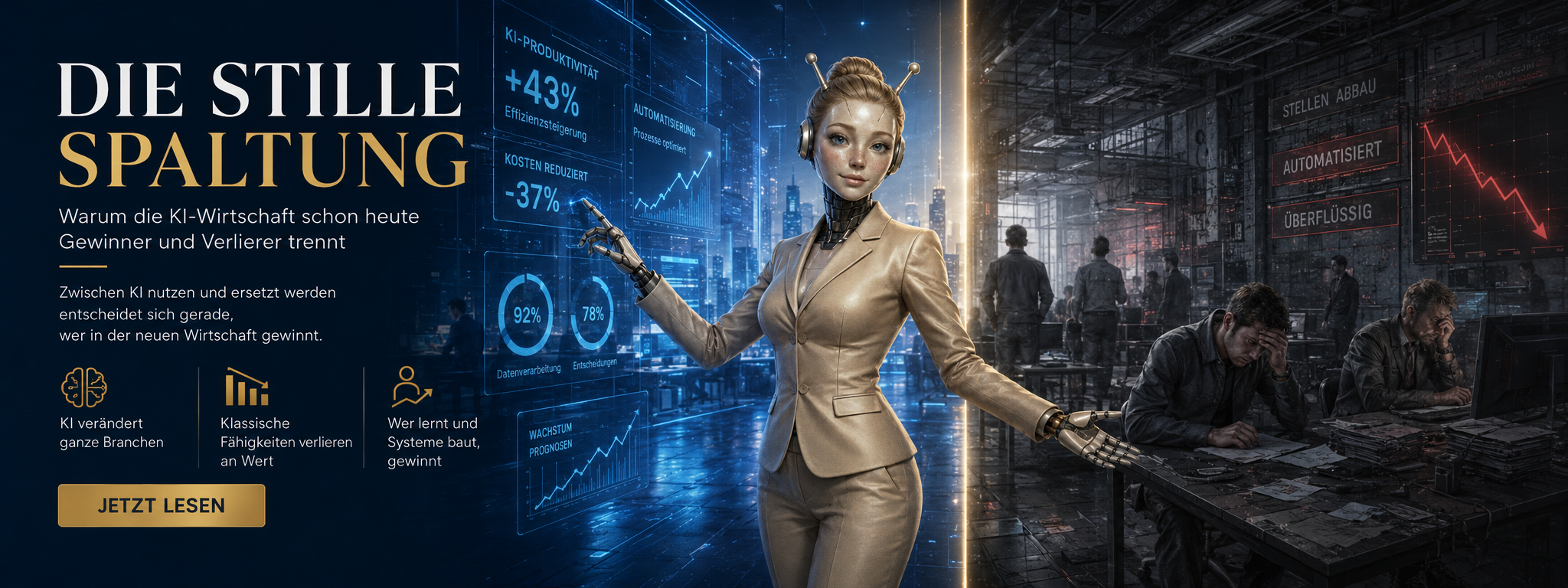
The answer: they happen indirectly. Companies don't lay off experienced employees. Instead:- Senior employees become more productive
- Fewer junior positions are being created
- New hires (22–25 years old) in AI occupations: −14 % since 2022
👉 The door to the labor market closes quietly - invisibly.
Long-term effects
Statistical models show:- +10 % AI coverage → −0.6 % employment growth
Strategies: What to do?
For experienced professionals
- Leveraging AI as a Productivity Booster
- Automate workflows
- Take on strategic tasks
For career starters
- Focus on skills that AI does not replace
- Communication, judgment, responsibility
For non-academics
- Craft and physical labor remain stable
- High future security in practical professions
For career changers
- Choose professions with social interaction
- Mastering AI as a Tool
Conclusion
The Anthropic study does not show an extreme scenario - but a differentiated reality. AI will not suddenly replace millions of jobs. Instead, it is changing them:- Access to the labor market
- Productivity requirements
- Value creation within professions
👉 The crucial question is not: "Will I lose my job?" - but: "Am I using AI better than others?"
The revolution is happening – quietly, but profoundly.



 Deutsch
  Deutsch (Österreich)
  Deutsch (Schweiz)
  English (Australia)
  English (Canada)
  English
  English (UK)
  हिन्दी
  العربية
  Türkçe
  Русский