
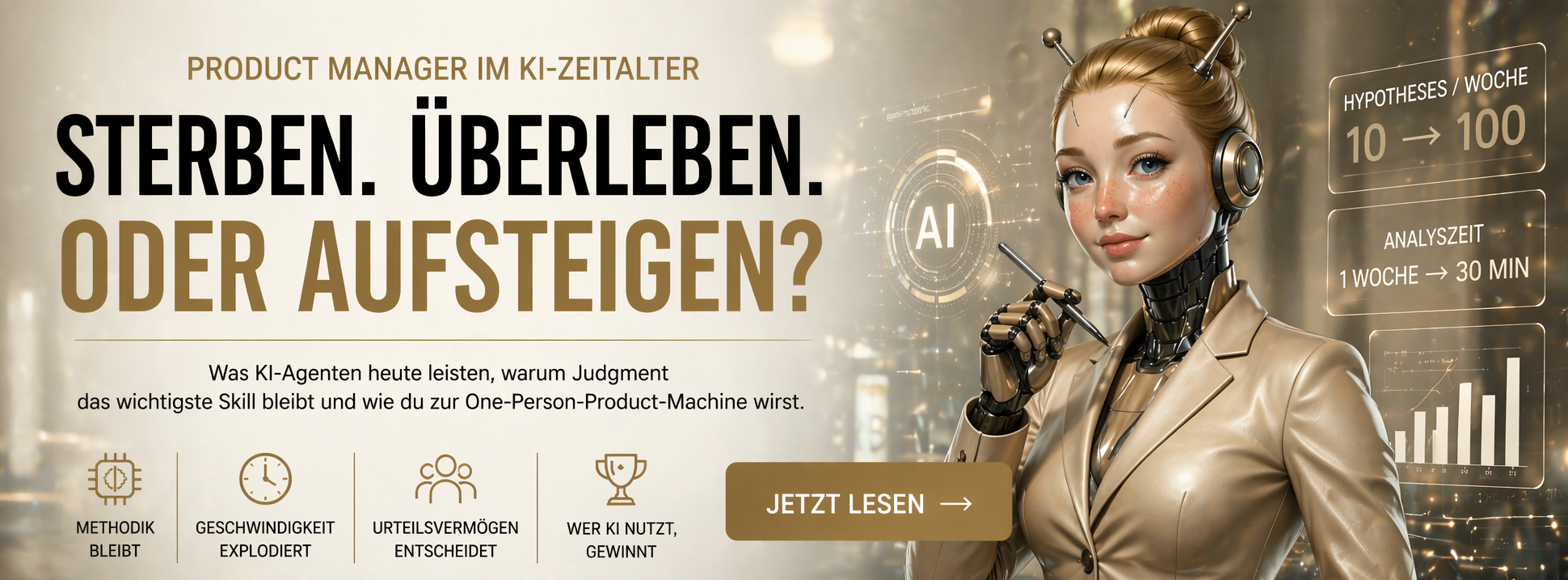
The question that torments everyone
Will AI take my job? This question is on the minds of product managers worldwide — and it's a valid one. Language models analyze user reviews, recognize patterns in data, formulate hypotheses, and create product strategies in minutes. So what's left for humans? An experienced product strategist and founder of his own product methodology has a clear answer. And it's surprising.No hype, but structural change
The expert describes a personal turning point: After he overcame his hesitation to work with Vibe Coding and AI agents, he built a complete product offering within a few hours — market analysis, landing page, payment integration, positioning. The first course sold out within a day. The second did as well.The dependence on other specialists disappears
The key thing: No designer, no developer, no analyst was needed. The dependency on other people—waiting for the next available specialist—was eliminated.
For him, this is nothing less than the most important professional event of his 20-year career.
What AI agents can do specifically
In another example, the expert shows how profound this change already is: He wanted to check if his 40-hour course actually contained several specialized courses for different user segments. This used to be a task for a team of analysts—taking at least a week. His approach today: He uploaded a CSV file with over 1,000 customer profiles to a shared repository, where the complete course transcript, his methodology, and hundreds of user questions were already stored. Then he gave an AI system a single task: Analyze the data, compare it with the old segmentation, find new segments, examine the course content, and suggest a possible breakdown.30 minutes instead of a week of analysis
Ten parallel AI agents worked on it — and delivered a structured result in 30 minutes that previously would have taken a week.
The methodology remains – but the speed explodes
The strategist works with an evolution of the classic Jobs to Be Done methodology. The core idea: the brain is a prediction machine. People don't buy features – they are looking for a more energy-efficient way to confirm their mental predictions. Those who build products must understand the user's task graph: What does someone want to achieve? What comes before it, what comes after? What overarching intention lies behind it? This chain of questions – "What for? And what for that?" – unfolds the true value of a product.Methodology + AI = Strategic Quantum Leap
This methodology has not become obsolete due to AI. On the contrary: the combination of structured product methodology and AI agents is a strategic quantum leap.
What used to take an analyst a week now takes five minutes.
The most important skill in the Age of AI: Judgment
If AI agents provide analyses, suggest segments, and prepare decisions – what's left for the product manager? The expert calls this business judgment: the ability to evaluate, question, and correctly contextualize AI outputs. However, he clarifies: judgment is not a mystical talent. It's the result of a clear product methodology that can be learned.AI provides options – humans evaluate
Anyone who understands how user behavior works, how value is created, and how markets are segmented can read AI results like a doctor reads an X-ray.
Vibe Coding: When the Team Suddenly Develops Itself
The expert describes another phenomenon with palpable enthusiasm: he has introduced his entire team to Vibe Coding—a method where you explain to AI models in natural language what you want to build, and the AI generates the code. The result: An employee who had never written a line of code built a complete job posting page with an admin interface—and generated 130 applications within a few days.Everyone can build — if they know what they want
Not an isolated phenomenon, but a pattern: Those who can think methodically will become a one-person production machine with AI.
The Great Reversal: Who is truly at risk?
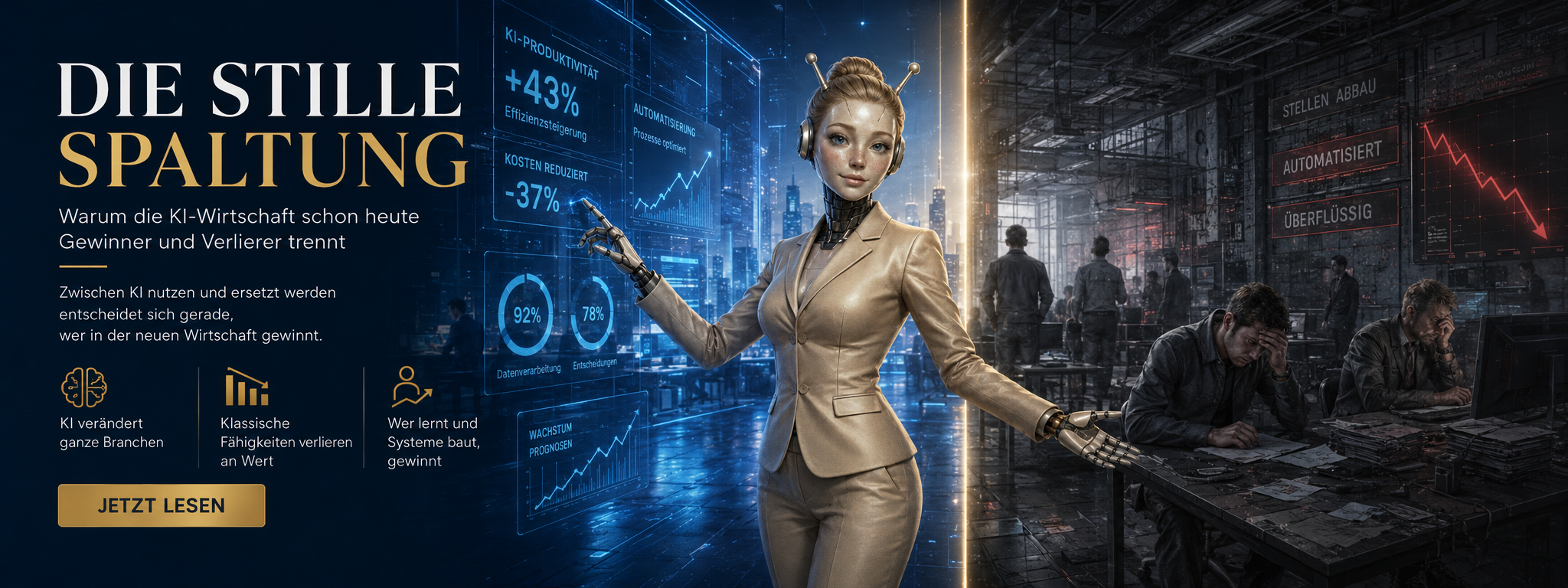
The fear of AI is justified—but the direction of the threat is misunderstood.👉 It's not AI that replaces you — it's someone who uses AI
AI is not replacing product managers. AI is replacing those who refuse to use it.
Those who adapt multiply their impact. Those who wait lose.
Do all of them become Product Managers?
One of the most provocative theses is: the role of the Product Manager is a concept of the old economy. In the new economy, everyone becomes their own Product Manager. If AI agents allow everyone to quickly test ideas, analyze markets, and build products — then passion becomes the deciding factor.Role becomes irrelevant — motivation decides
What to do now
The practical recommendation is specific: The most important thing is to deploy the first MVP on a server. This takes two to three hours. What happens afterward is an irreversible change.The first launch changes everything.
For all those who are afraid of the first step: Fear is biologically sensible. The only question is whether it leads to paralysis or action.
Additionally, people need psychological anchors in uncertain times — family, health, routine, purpose.
Conclusion: A revolution that rewards courage
The message is not a dystopia — but an invitation.AI multiplies; it doesn't replace.
Product Managers who understand AI as a tool will not be replaced. They will be amplified.
The only question that matters:
What do you want to build, and why haven't you started yet?
Editorial Note:
This article is based on an expert interview with an experienced product strategist and founder of a structured product methodology. The statements reflect the expert's personal opinion.
 Deutsch
  Deutsch (Österreich)
  Deutsch (Schweiz)
  English (Australia)
  English (Canada)
  English
  English (UK)
  हिन्दी
  العربية
  Türkçe
  Русский