

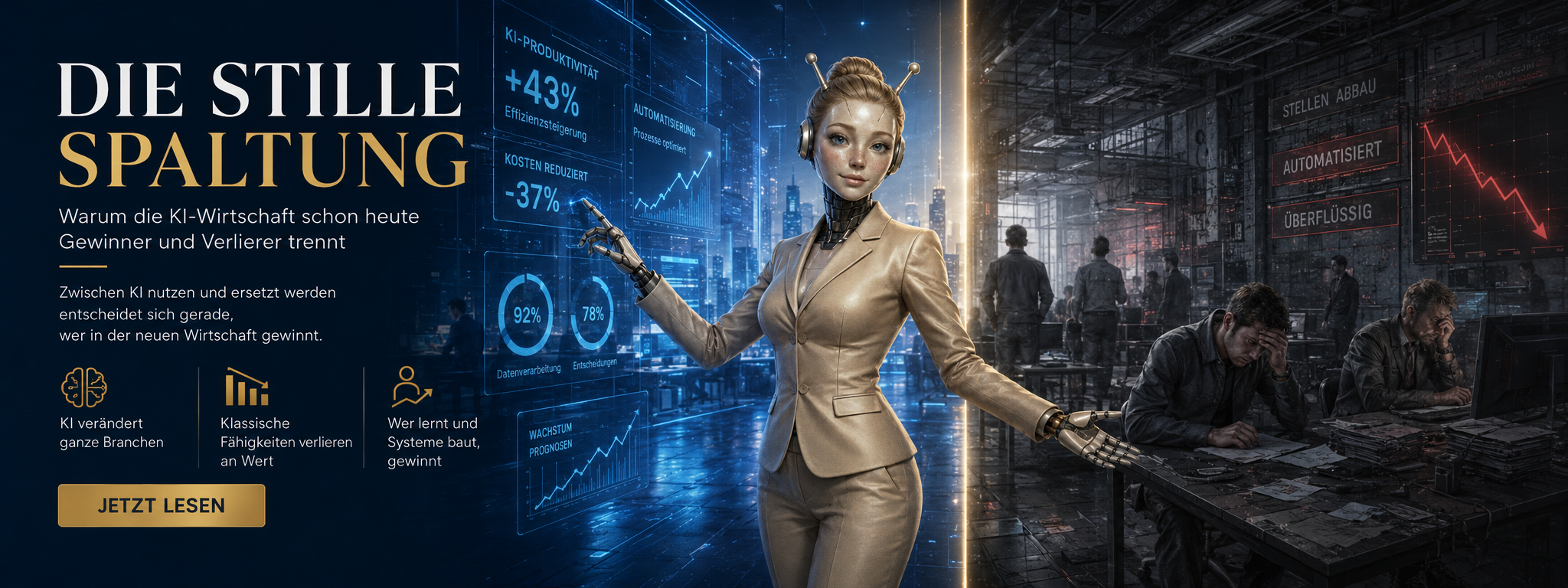
The debate about artificial intelligence in the job market is often reduced to two extremes. One side warns of Mass unemployment and the end of traditional office jobs. The other claims that AI is merely a useful tool that makes people more productive, but does not cause fundamental upheavals. The reality lies in between — and that's exactly what makes the current development so serious.
Because AI is not changing the labor market in a single, spectacular break. It's changing it step-by-stepFirst invisible, then noticeable, and finally structural. Today, we mainly see more efficiency, more speed, and more automation in knowledge work. But behind this increase in productivity, a new logic for the employment market is already growing: fewer entry-level opportunities, higher demands, more pressure on existing teams, and in the long term, a possible shift in the entire professional landscape.
AI does not immediately replace people - it first changes the rules of the game
In many companies, AI is not yet a direct replacement for entire departments. Much more frequently, it is used as Amplifier deployed. With the support of AI, one specialist can today take on tasks that previously required two or three people: research, drafting, evaluation, communication, documentation, analysis, or prototyping can be significantly accelerated.
At first glance, this sounds positive. Companies save time, employees deliver results faster, and processes become more efficient. However, it is precisely in this early phase that the real shift begins. Because when a team with fewer people accomplishes the same amount of work, the pressure to hire new people automatically decreases. The consequence is not immediate dismissal, but initially a Slowing of recruiting.
Why career starters are the first to feel the change
Are particularly affected young professionals, juniors, trainees and graduatesIn many knowledge-based professions, companies need less entry-level support if experienced employees can achieve more with the help of AI. From a company's perspective, this seems rational: Why invest in training a junior employee when an experienced person with AI can complete the same standard tasks faster and more reliably?
However, a structural problem arises precisely here. Senior professionals don't grow on trees. You develop from junior roles, from learning phases, from mistakes, from mentoring, and from real-world practical experience. If these entry-level opportunities become rarer, there is a long-term risk of a gap in the career development chain.
The real danger: not just automation, but intensification of work
Another misconception in public debate is: If AI takes over tasks, shouldn't humans actually be relieved of their burden? In practice, often the oppositeThose who work with AI don't just do the same work faster and go home earlier. More often than not, their workload actually increases.
Employees are taking on additional tasks, reacting faster, working on more topics concurrently, and experiencing more blurred lines between work and rest. Productivity is increasing, but often at the cost of higher mental strain.
Which professions are under particular pressure
The professions currently under the most pressure to change are those whose core tasks are highly digital, language-based, documentation-heavy or analytical:
- Software Development
- Customer Service
- Data Collection & Marketing Analysis
- 🧪 Testing & Financial Analysis
- 📋 Administrative Roles
- 💼 Parts of Sales and Knowledge Work
For a long time, these professions in particular were regarded as secure fields of advancement for the middle class: well paid, academic and socially recognized. Now a ParadoxActivities that are closely related to information, language, and standardized thought processes are precisely the ones that can be automated particularly well with AI.
Less affected are, for the time being, activities that require physical presence, craftsmanship, situational action, or direct work in the real environment: construction, gastronomy, skilled trades, maintenance, emergency services, or on-site technical work.
Why this can become a macroeconomic problem
What happens when companies become more and more efficient, but at the same time fewer people earn income from these activities?
paradoxum. dangerous contradictionCompanies produce more efficiently, but some of the previous purchasing power disappears.
Three phases of change
Phase 1: Efficiency Without a Visible Crisis
Productivity is currently rising, primarily. AI is being used as a tool, hiring is more cautious, and existing teams are carrying more of the load. The labor market appears stable on the surface, but entry barriers and career paths are already changing significantly beneath the surface.
Phase 2: Fewer New Hires, Initial Displacement
Companies are questioning more strongly which roles still need to be fully staffed. First, entire professions don't disappear, but rather individual task packages do. Job profiles are emerging with fewer junior positions and more expectations of versatile skilled workers.
Phase 3: Pressure on Consumption, Wages, and Education
As the gap between technical feasibility and real-world AI deployment continues to narrow, the pressure on wages, qualifications, and employment models is noticeably increasing. It's no longer about individual tools, but about a new architecture of work.
What employees should do concretely now
Those who are working today should not panic, but they also should not remain passive.
1️⃣ Honest self-assessment.
Which parts of your own work are standardized, repeatable, or rule-based? That is precisely where the pressure for change is highest.
2. Use AI actively in everyday life.
Not as a gimmick, but as a working tool. Those who integrate AI meaningfully increase their own relevance.
3. Build visibility.
Document what was concretely achieved and what business benefit your work had.
4️⃣ Breadth of expertise instead of a specialist trap.
Becoming Valuable: Prioritization Under Uncertainty, Communication, Negotiation, Judgment, Strategic Thinking.
5️⃣ Protection against exhaustion.
Being more productive shouldn't mean being available around the clock.
What's changing for job searching and career planning
The labor market will more demanding - not necessarily smaller immediately, but more selective. Pure entry-level skills lose value if they can easily be supplemented with AI. On the other hand, profiles that combine specialist knowledge with technological understanding gain in value.
This also affects educational decisions. Rigid training paths, which prepare for a narrow occupational profile over several years, are coming under pressure to justify themselves. Anyone investing in education today should not only focus on a professional title, but on transferable skills, practical experience, and adaptability.
Conclusion: The warning signs are there, but there is still time to act
The labor market is not at an end, but in the midst of a fundamental ReorganizationAI is already having an effect – not always through spectacular waves of layoffs, but often much more quietly: through a reduced willingness to hire, increasing demands, condensed work, and new expectations of employees.
This is precisely why the current phase is so important. Much is still undecided. There is no irreversible end state yet. But the direction of development is clear: Standardizable knowledge work will come under greater pressurewhile adaptability, contextual competence and genuine responsibility are gaining in importance.
Those who recognize this change early can prepare for it.
Those who wait risk being surprised by a job market that has already changed its rules.


 Deutsch
  Deutsch (Österreich)
  Deutsch (Schweiz)
  English (Australia)
  English (Canada)
  English
  English (UK)
  हिन्दी
  العربية
  Türkçe
  Русский