
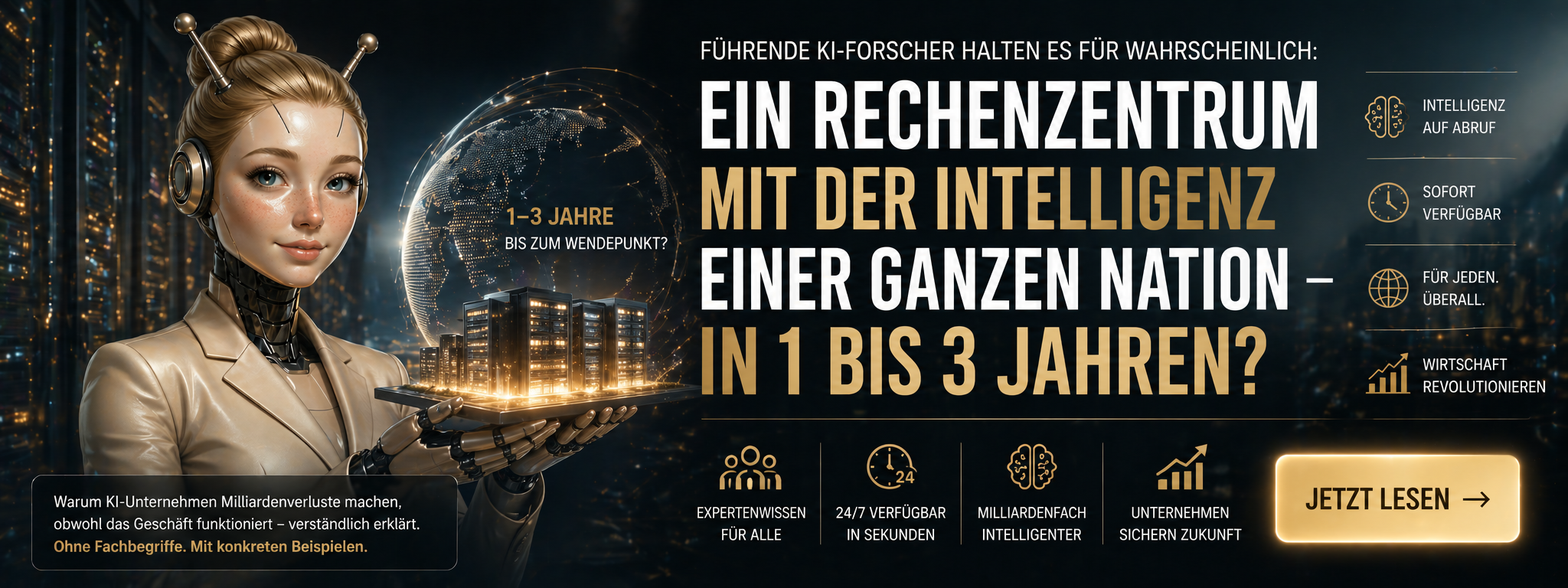
A strange question with an even stranger answer
What if you woke up tomorrow morning and had a specialist on hand for every task? A doctor to analyse your symptoms. A lawyer to review your contract. An engineer to write your code. A business consultant to think through your business strategy. And all of that – simultaneously, instantly, around the clock, for everyone in the world. Sounds like science fiction? Leading researchers in the AI industry say: this could be a reality in one to three years. Not for all tasks. Not perfectly. But surprisingly close. They call the scenario "the land of geniuses in the data centre": a data centre operating with the combined intelligence of an entire nation of gifted individuals.How did AI get so good so quickly?
To understand what's happening, a simple image helps. Imagine teaching a child to read. First, it learns individual letters. Then words. Then sentences. Then books. And the more it reads, the better it gets — not just at reading, but at thinking, inferring, explaining. This is exactly how modern AI training works — only at a speed and scale that no human could ever achieve. Today's AI systems have metaphorically read more than a thousand people in a thousand lifetimes combined.The result: AI models that were at a student's level three years ago are now solving doctor-level tasks today — in medicine, law, mathematics, and programming.
And the crucial observation is: the more computing power and data you give the system, the better it gets — astonishingly reliably, almost like a law of nature. Researchers call this "scaling".
When will the turning point come?
Leading AI researchers, who work with these systems daily, openly state: they are convinced that we will experience this turning point. Their assessment:- With a probability of about 50% it will happen in the next one to three years.
- With a probability of 90 to 95% it will happen in the next ten years.
For comparison: Nobody knows exactly when the next earthquake will come. But geologists are very sure that it will come. The situation here is similar – only that the timeframe is measured in years, not centuries.
Why AI is still not human
Here's something that surprises many: AI systems learn fundamentally differently from humans. A child learns that hot cooker = pain by touching it once. It doesn't need a thousand repetitions. An AI system, on the other hand, needs huge amounts of data to understand similar relationships. Why is that? Because our brain doesn't start from scratch. Over millions of years, evolution has equipped us with basic instincts, reflexes and learning abilities. An AI system literally starts with random values - like a blank sheet of paper. That's why it has to read and process so much in order to perform similarly. But here's the fascinating thing: Once this training is complete, the systems simply know more than any individual human in many areas. A well-trained AI system knows more about medicine than most doctors. More about tax law than most tax advisors. More about history than most historians. Not because it "thinks" better - but because it has read more.The misunderstanding with programming
A concrete example that explains a lot: programming. For some time now, AI has already been writing the majority of code in some companies. Many conclude from this that AI will soon replace all programmers. But that is a misunderstanding. There are several very different stages:- AI writes 90% of the lines of code — that sounds like a lot, but says little. A compiler also "writes" all the lines of code.
- AI handles 90% of a developer's tasks — that's a much stronger statement.
- The demand for developers is falling by 90% — that is the economic consequence, which is still further away.
Two curves you should know
To understand the next few years, a simple image helps: there isn't one development, but two. Curve 1 — What AI can do: This curve reliably rises steeply. Models improve monthly. This is well-evidenced and continuing. Curve 2 – what reaches the economy from this: This curve follows the first one, but with a delay. An example: A new AI tool for programmers can be introduced by a startup in a week. A large corporation with 50,000 employees needs months for this – not because the tool is worse, but because it requires contracts, data protection checks, IT approvals, training, and internal authorisations.This is not a weakness of the technology. This is the completely normal process when an innovation arrives in large organisations.
Nevertheless: this second curve will proceed faster than with any previous technology. For comparison: the internet took around 20 years to fundamentally change the economy. AI will do this significantly faster.
Why AI companies are making losses – and why that’s not a problem
A question on many people's minds: If AI is so good and so in demand, why are the leading AI companies making losses at all? The answer lies in a simple problem: you have to plan for the future. Imagine you're opening a restaurant. You have to build and equip the kitchen a year in advance – before you know how many guests will come. If more come than expected, you'll make a lot of money. If fewer come, you've invested too much. Data centres work exactly like this. AI companies have to order capacity 12 to 24 months in advance – before they know how big the demand will be. The enormous losses therefore don't mean: "These companies don't work." They mean: "These companies are betting aggressively on the future."And the figures so far speak for them: a leading AI lab grew from €100 million in annual revenue to €1 billion – in a single year. The following year, it grew to almost €10 billion. Such growth has rarely been seen in economic history.
How many providers will there be?
Another important point: will there be a single winner at the end, or several? The answer: probably several. And the model is the cloud computing market. If you want to store data in the cloud today, you have three to four major providers to choose from – Amazon, Microsoft, Google, perhaps another one. Not an absolute monopoly, but also not free competition with a hundred providers. Why? Because building this infrastructure is so expensive and complex that only a few companies can manage it. Anyone wanting to enter today would have to not only invest billions but also develop years of accumulated know-how from scratch.The same applies to AI: three, perhaps four, big providers. Each with their own strengths. And all profitable—once growth stabilises.
What happens after the turning point?
Let's assume that the "land of geniuses" is actually a reality in three years' time. What then? Then it will become clear that the real questions are not of a technical nature. The technology will come. The difficult questions will be different:- Who benefits from this? The developers of the systems, the companies that use them – or everyone?
- How quickly do new medicines and medical breakthroughs reach sick people?
- What happens to countries and regions that lag far behind technologically?
An expert puts it this way: "Economic growth will come – almost by itself. What doesn't come by itself is that everyone benefits from it."
What that means for normal people
Many are asking: What does this have to do with me? The honest answer: a great deal – but not immediately. Specifically, you can expect the following in the coming years:- Medical diagnoses are becoming faster and more precise.
- Legal and tax advice will become cheaper.
- New medicines are coming onto the market faster.
- Many routine office jobs are disappearing, but new ones are emerging.
Conclusion: No reason to panic – but a reason to pay attention
The key messages: AI will be better than any single person in most knowledge professions in the coming years. It will take some time before this is truly noticeable in everyday life. The crucial question is who will shape it.Historians will look back on these years one day and wonder how little most people understood of it then.
Editorial note:
This article is based on a conversation with a leading AI researcher and business executive about the current state and future of artificial intelligence. The forecasts reflect the expert's personal assessment.

 Deutsch
  Deutsch (Österreich)
  Deutsch (Schweiz)
  English (Australia)
  English (Canada)
  English
  English (UK)
  हिन्दी
  العربية
  Türkçe
  Русский